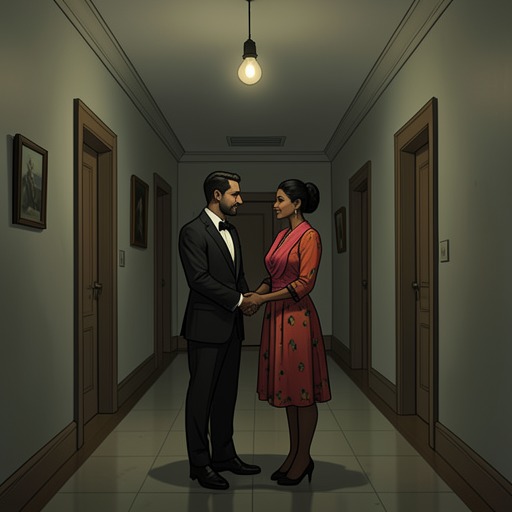
“A Bloodless Excuse for a Marriage”
The RadleysA Bloodless Excuse for a Marriage gives Peter Radley’s fear of marital emptiness a vampire-specific form: he imagines that he and Helen Radley may remain together without the intimacy that blood once represented to him. The phrase turns their abstention from drinking into an accusation about their relationship, while Helen’s resistance makes clear that they attach different meanings to blood and to the marriage itself.
The phrase and its immediate context
The phrase appears as Peter argues that abstinence has come to feel like more than a rule governing what the Radleys drink. He tells Helen that if they are “like this,” there is little point in being together, and pictures their future after the children leave for university: the two of them, “trapped in this bloodless excuse for a marriage.” The expression is not simply a complaint that their marriage lacks physical intimacy; in context, it names Peter’s sense that their shared life has lost an important form of connection.
The imagined future gives the phrase its force. Peter looks beyond the immediate argument to an empty house and a marriage that, in his view, will have no shared purpose once parenting no longer occupies them. His wording makes abstention and emotional estrangement seem to converge: a marriage can continue in name while feeling bloodless to one of its partners.
Blood as intimacy and disagreement
Peter proposes that he and Helen taste each other’s blood occasionally, recalling that they did so in Tuscany, the Dordogne, and at Christmas at her mother’s. His question about how long it has been turns a list of past occasions into evidence of distance: the practice that he remembers as intimate has become rare. He is surprised by the anger in his own voice, and the argument escalates as Helen rejects the subject and pulls the duvet sharply.
Helen calls the discussion a midlife crisis and tries to end it for the night. Her response contrasts with Peter’s insistence that blood could renew their closeness. The disagreement is therefore not only over whether to drink: Peter treats sharing blood as a possible expression of their bond, while Helen resists making it the measure of whether their marriage is worth sustaining.
Abstention, secrecy, and the family
The phrase gains further context from Peter’s role in maintaining the family’s account of its condition. As a doctor, he knows how reassurance and confidence can affect patients, and sometimes justifies his deceptions as coloring the truth like a pill. But he finds that justification increasingly difficult. His professional practice of softening or disguising the truth sits uneasily beside the family’s secret, which Helen initially explains to Clara Radley as an inherited illness and a carefully managed hunger before Peter tells Clara plainly that the family are vampires.
The Radleys’ abstainer identity is also a family inheritance rather than a choice shared equally by every member in the same way: Peter tells Rowan Radley that he was born a vampire and that the Radleys have been so for generations, while Helen was converted. Against that background, Peter’s wish to taste blood with Helen presses on the boundary between abstention as a principle and blood as part of their history. The phrase does not resolve that conflict; it gives Peter’s marital dissatisfaction the language of the very thing their family has tried to refuse.
Significance
The expression is pointedly paradoxical. Peter describes his marriage as bloodless while asking to bring blood back into it, making the substance both the source of the family’s danger and, in his argument, a possible means of intimacy. His metaphor also narrows a complicated marital problem into a dramatic verdict: he fears that shared domestic life may persist without the connection he wants, whereas Helen does not accept blood tasting as the remedy. The phrase thus captures a mismatch in how the couple understand closeness, not a settled judgment that their marriage is over.